

AI agent orchestration platforms coordinate the models, tools, data, and approval steps involved in getting work done. The right choice depends on who builds the system, where the data lives, and who takes responsibility when an action fails. These ten options span business applications, cloud infrastructure, developer frameworks, and automation tools, with different costs and implementation work.
AI agent orchestration platforms at a glance
| Platform | Where it fits | What to check before buying | Cost model |
|---|---|---|---|
| Jet Admin | Business apps and workflows on existing company data | Configure the agent workflow, operational screens, and appropriate access controls | Free plan; paid AI-credit plans with unlimited users |
| Microsoft Copilot Studio | Agents connected to Microsoft and Power Platform services | Publishing channels, connector access, and credit consumption | Pre-purchase or pay-as-you-go Copilot Credits |
| Salesforce Agentforce | Customer-facing and employee processes around Salesforce | Data connections, action permissions, and separate consumption charges | Flex Credits, conversation pricing, and license options |
| UiPath | Processes combining agents, software robots, and people | Maestro capabilities, robot licenses, and process ownership | Free entry option; broader Standard and Enterprise plans by quote |
| Google's former Vertex AI Agent Builder | Developer-built agents on Google Cloud's current Gemini platform | Current service names, runtime, identity, and cloud usage charges | Budget the services and models used |
| Amazon Bedrock Agents Classic | Existing deployments; new customers should evaluate AgentCore | Classic maintenance status and the migration path | Budget models and the selected AWS services separately |
| LangGraph | Custom, stateful agent execution in code | Persistence, operations, identity, and deployment responsibilities | Framework plus model, hosting, and optional platform costs |
| CrewAI | Role-based agent teams inside structured flows | Flow boundaries, tool permissions, and hosted plan controls | Framework or hosted Free and Custom offerings |
| n8n | Agent steps within integration workflows | Execution limits, approval behavior, and hosting requirements | Execution-based paid plans; self-hosted Community Edition available |
| Gumloop | Shared business agents with connected tools | Credits, orchestration fees, credentials, and governance options | Pro subscription and credits; Enterprise by quote |
This comparison uses official product documentation and pricing retrieved October 30, 2026. Jet Admin publishes this article; the recommendations are editorial assessments of documented capabilities, not a hands-on performance ranking. Homepage screenshots illustrate the products and may show earlier branding.
What an orchestration system needs to control
A useful system does more than pass a message from one agent to another. It needs to preserve the business process when a model produces an incomplete answer, a tool times out, or somebody needs to approve an exception.
- State: which steps finished, what information was collected, and what remains unresolved.
- Tool access: which systems an agent can read or change, using which identity.
- Approvals: the exact action and parameters a person reviews before execution.
- Recovery: how a failed step resumes without repeating a payment, message, or record update.
- Visibility: a record of inputs, tool calls, outcomes, and the person responsible for exceptions.
- Cost: what a completed business task consumes, including retries and external services.
Start with one process and identify where judgment is useful. Fixed rules can handle routing and validation while an agent interprets a request or drafts a response. Adding another agent should solve a specific coordination problem, rather than make a simple workflow harder to inspect.
1. Jet Admin: business workflows on existing data
Jet Admin combines business apps, workflows, and AI agents with connections to existing databases and services. Its product page lists 200+ integrations, including PostgreSQL, Airtable, Google Sheets, and REST APIs. That makes it relevant when the workflow needs operational screens as well as an agent.
Where it fits
Consider a support process that reads a customer record, drafts a response, and places exceptions in a review queue. The useful deliverable includes the queue, status fields, access rules, and an operator's next action. Treat that example as a workflow to configure and test, not a claim that every step or integration is supplied as a finished template.
Pricing and limitations
The pricing page lists a free plan and paid plans based on AI credits, with unlimited apps, users, and workflows. Granular permissions, single sign-on, and audit logs require Business or above; on-premise deployment is Enterprise. Confirm the credit rules and required controls for your intended deployment.
Your team still needs to define allowed actions, failure handling, and integration behavior. If the main requirement is a custom research architecture or a low-level execution graph, compare a developer framework before choosing an app builder. If people need to operate the process every day, include those screens in the evaluation.
2. Microsoft Copilot Studio: agents in the Microsoft environment
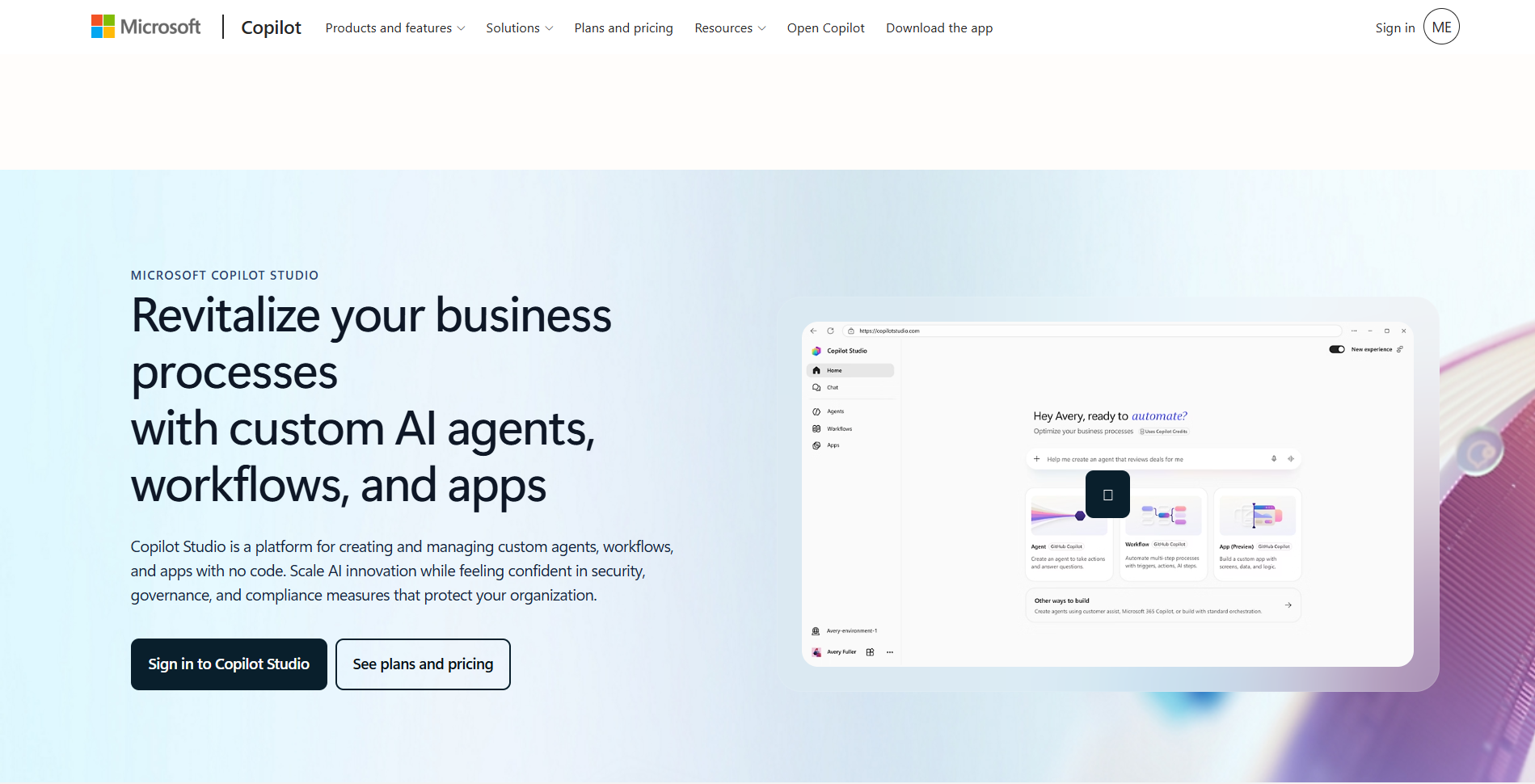
Microsoft Copilot Studio supports agent creation, Power Platform connectors, and publishing to internal or external channels, depending on the offering. Its pricing comparison also describes Dataverse, environment management, and administration through Power Platform.
Where it fits
It belongs on the shortlist when employees already use Microsoft's identity and productivity services. Test a real request across the systems it touches: finding a policy, checking a business record, and requesting an action. A useful demonstration shows whose credentials the connector uses and what happens when the requester cannot access the underlying record.
Pricing and limitations
Microsoft lists prepaid and pay-as-you-go Copilot Credit options. Microsoft 365 Copilot's included agent-building capabilities and standalone Copilot Studio publishing rights are different purchasing questions. Ask for a calculation based on your channels, actions, and expected usage rather than treating a listed license figure as the entire operating cost.
Check premium or custom connectors and the exact environments required for deployment. A familiar Microsoft interface does not settle the integration design, permissions, or exception workflow. Include an administrator in the pilot so those requirements are evaluated before the agent is shared widely.
3. Salesforce Agentforce: agents around customer processes
Agentforce is relevant when sales, service, or other customer processes already run through Salesforce. Its pricing documentation distinguishes Flex Credits, conversation-based consumption, and user-license options, rather than one universal agent subscription.
Where it fits
Evaluate it using a case that crosses the customer record and an external system. Salesforce documents Data 360 zero-copy access for supported external data sources, including use by Agentforce. External data does not always need to be physically imported first; availability, configuration, and the selected connection still matter.
Pricing and limitations
The published US comparison lists $500 per 100,000 Flex Credits and a $2-per-conversation option. Those are different meters, and Salesforce notes that examples can exclude Data 360 or other consumption services. Ask which actions consume credits, which licenses apply, and what data access adds to the quote.
The practical constraint is the complete Salesforce implementation: permissions, data relationships, actions, and supporting services. Test a request with missing customer information and one that requires escalation. A successful answer is less useful if the agent cannot explain which record changed or who owns the exception.
4. UiPath: orchestration across agents, robots, and people
UiPath Maestro coordinates AI agents, software robots, APIs, and human steps. Its product documentation describes persistent process state, live-instance controls, and process history. Robotic process automation, or RPA, is useful when work includes interacting with software through its interface.
Where it fits
UiPath is worth evaluating when a process spans modern APIs and older applications. For example, a document-processing step might feed a robot that enters information into another system, with a person handling exceptions. Ask the vendor to demonstrate a failed step and a resumed process, as well as the normal path.
Pricing and limitations
The pricing page includes a free Community option and quote-based Standard and Enterprise offerings. It also notes that users and robots may require additional license purchases. Confirm the plan and consumption requirements for the actual Maestro, agent, and robot components you will use.
This is a broader automation purchase than adding one model call to a workflow. Include the people responsible for robot maintenance and process changes in the decision. If all required systems have reliable APIs and the process is small, compare that implementation effort with a narrower automation tool.
5. Google's former Vertex AI Agent Builder: the current Gemini platform
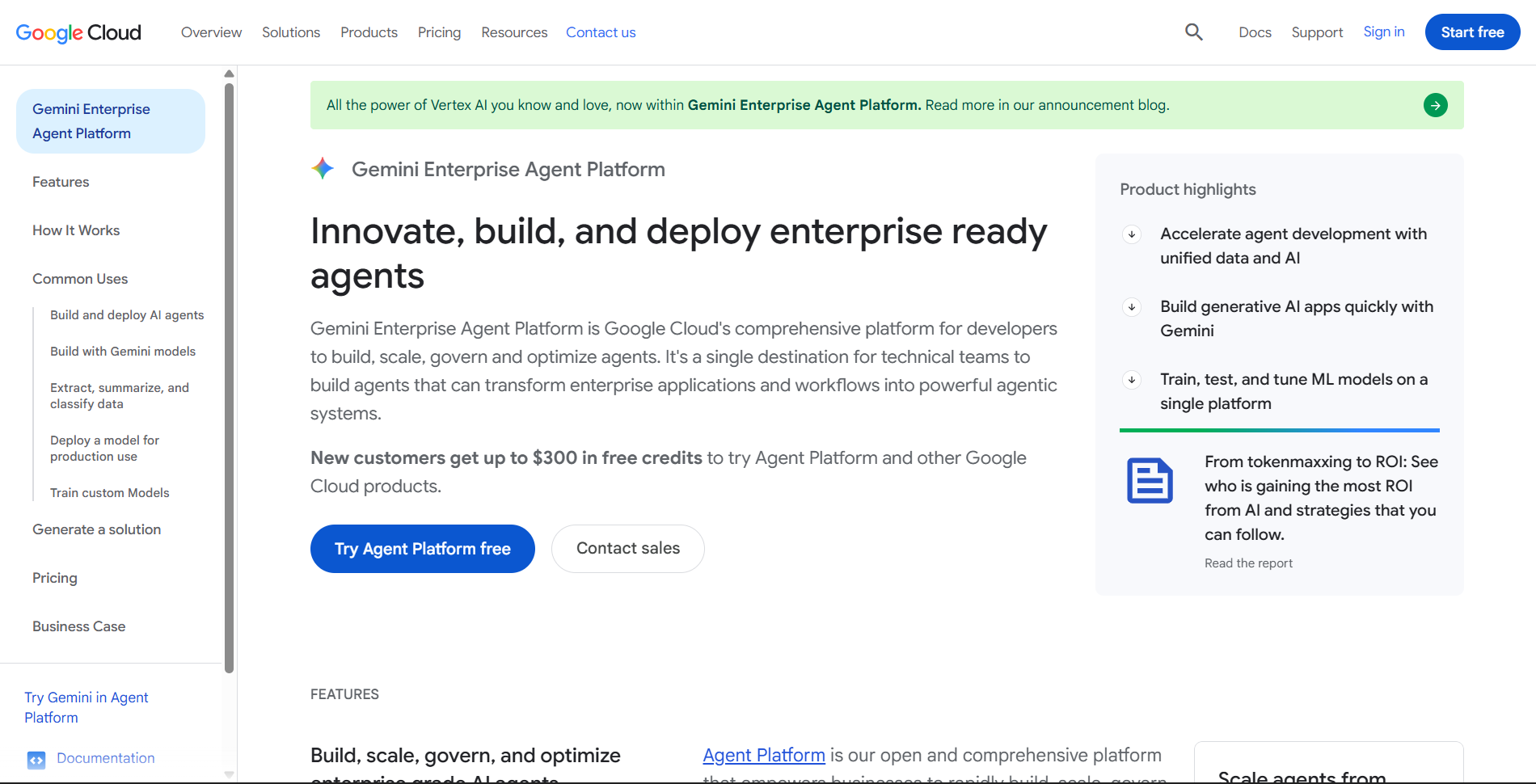
The former Vertex AI Agent Builder product URL now redirects to Google's Gemini Enterprise Agent Platform page, whose current heading is “Gemini platform.” Keep this naming change in mind when comparing older tutorials with the console and current documentation.
Where it fits
Google's runtime documentation covers deployment, access management, tracing, logging, sessions, and agent frameworks including ADK and LangGraph. It is relevant when developers want a managed Google Cloud environment around their agent application.
Use a pilot to establish the boundary between the agent code and the managed services. Identify who provisions identities, where session data is stored, how traces are inspected, and how an operational user sees a failed task. Managed infrastructure still needs an application-specific operating model.
Pricing and limitations
Budget the selected model, runtime, storage, and connected cloud services as separate requirements; request current rates for the architecture and region you will deploy. A free-trial credit is not a production cost estimate. This is a developer-platform decision, so include deployment and application maintenance in the comparison.
6. Amazon Bedrock Agents: check the Classic maintenance notice
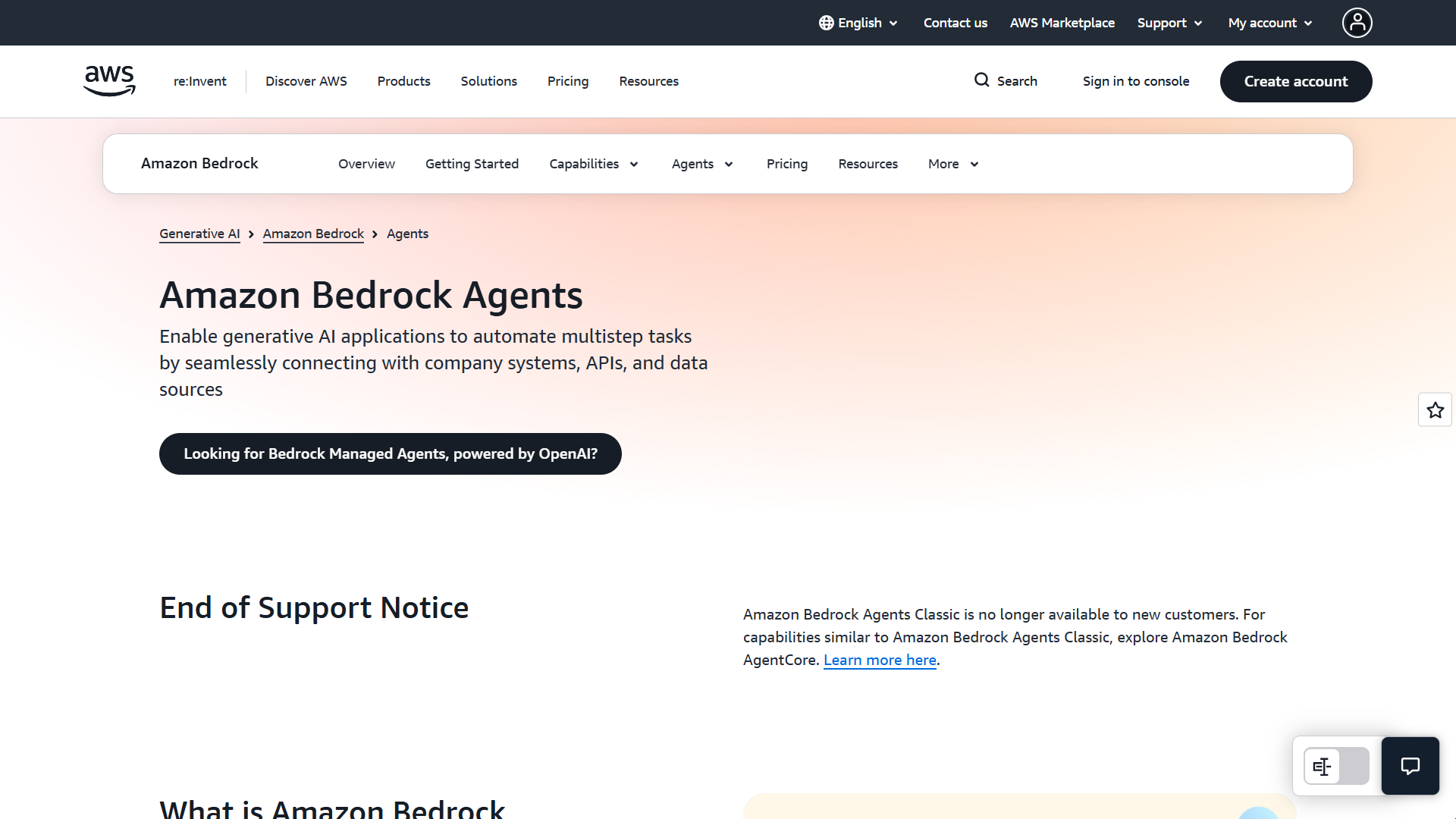
Amazon's current documentation calls the original service Bedrock Agents Classic. It describes agents that use action groups, APIs, and knowledge bases to complete tasks. The service's availability now matters more than its original feature list.
Where it fits
The maintenance-mode notice states that Classic stopped accepting new customers on July 30, 2026; existing customers can continue using it. AWS points new evaluations toward Amazon Bedrock AgentCore and documents migration options for existing deployments.
Pricing and limitations
For an existing installation, inventory its action groups, knowledge bases, identities, and execution behavior before estimating migration work. For a new project, evaluate the current AgentCore architecture and its charges alongside model and connected-service usage. Do not base a new purchasing decision on an old Bedrock Agents tutorial alone.
Test how the replacement handles a paused action, a tool error, and a repeated request. A migration should preserve the business outcome and access boundaries, not simply reproduce the original agent's prompt. Keep a record of the differences that affect operators or downstream systems.
7. LangGraph: custom agent execution with state
LangGraph is a low-level orchestration framework for stateful agent applications. Its documented capabilities include durable execution, persistence, streaming, and human oversight. It supports systems that mix fixed control flow with agent decisions.
Where it fits
Choose it for evaluation when developers need explicit control over state transitions, branches, or a process that pauses and resumes. A review step should be demonstrated with the saved state and proposed action visible. Test a restart while approval is pending, rather than stopping at a successful notebook example.
Pricing and limitations
Distinguish the framework from the broader platform. The documentation links LangSmith for tracing, evaluation, and deployment, so self-managed hosting is not the only path. Compare model charges, persistence infrastructure, engineering effort, and any managed services you select instead of treating the framework as the complete cost.
LangGraph gives developers execution primitives; your application still needs appropriate identities, tool permissions, and an interface for its users. Define who maintains those pieces. It is a stronger candidate when custom execution behavior is central to the product than when the main requirement is a simple approval form.
8. CrewAI: agent teams inside controlled flows
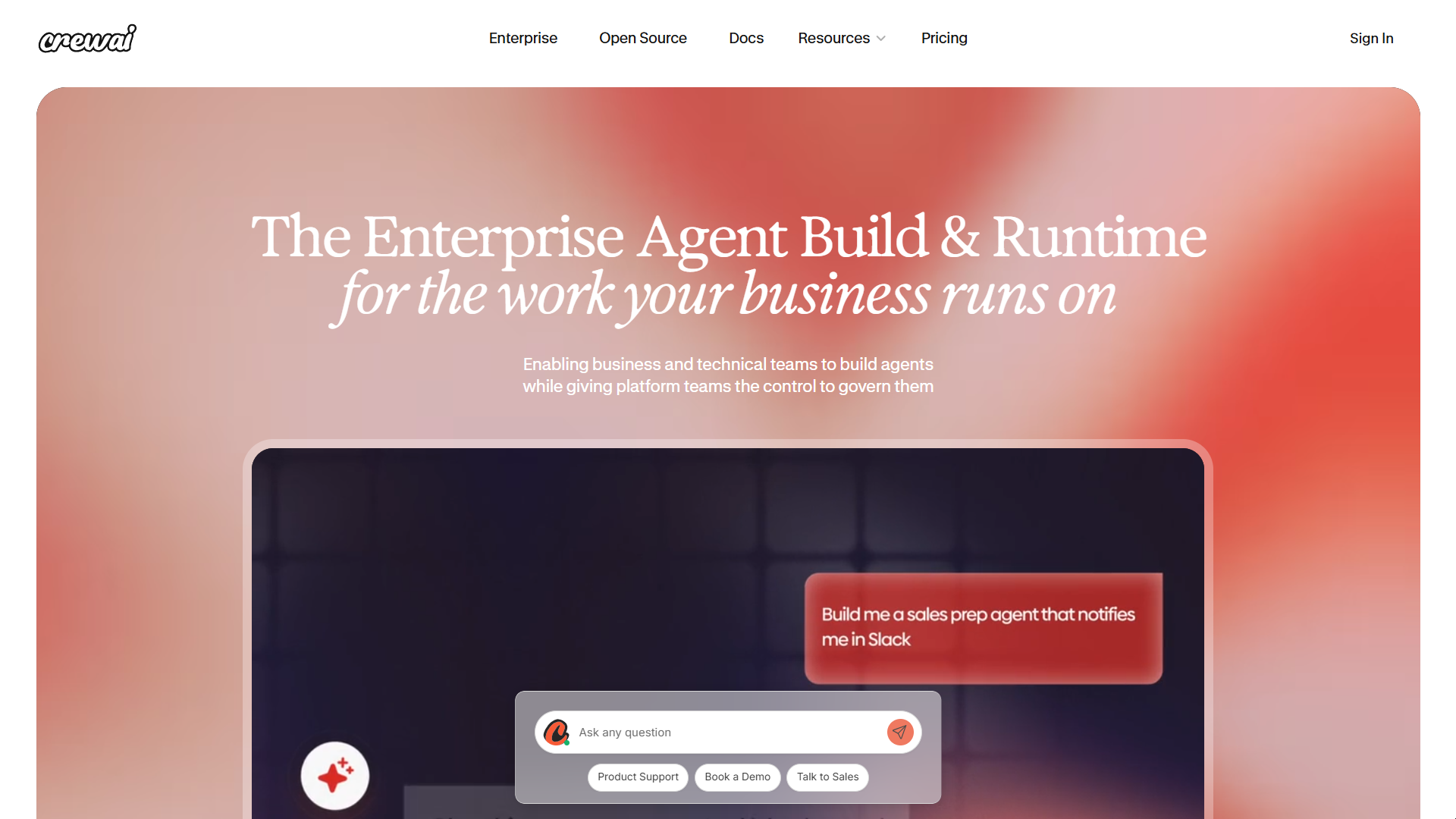
CrewAI distinguishes Crews, which organize agents around roles and tasks, from Flows, which manage state, events, and execution logic. Its documentation recommends starting production applications with a Flow and using a Crew where collaborative agent work is useful.
Where it fits
A research-and-review process is a useful evaluation case: one component gathers evidence, another produces a draft, and a defined workflow decides whether the output is ready. Require a structured result at each boundary. Adding role names does not prove the agents agree on what a complete result contains.
Pricing and limitations
Separate the framework from CrewAI's hosted plans. The current page lists Free and Custom offerings, with governance features such as single sign-on and role-based access described under Custom. Check the execution allowance and controls for your proposed deployment.
Do not assume every production feature must be built from scratch, or that a hosted feature is automatically present in a local framework installation. Map the tools each agent can invoke and define a clear owner for rejected or incomplete work. Evaluate the flow's failure paths as carefully as its agents' output.
9. n8n: agent tools inside integration workflows
The n8n AI Agent node connects a chat model and tools, allowing the agent to choose tool calls within a workflow. The surrounding workflow can handle triggers, data transformations, and defined integration steps.
Where it fits
It is a candidate when the main problem is connecting systems with a few places that need language understanding. n8n also documents human review for individual agent tools: execution pauses while a reviewer approves or denies the proposed call. Approval handling is an available capability to test, rather than something to dismiss as absent.
Pricing and limitations
The pricing page bases paid plans on workflow executions and lists a self-hosted Community Edition. Check the applicable execution allowance, hosting arrangement, model usage, and plan requirements for identity and governance features.
Self-hosting creates operational work: credentials, upgrades, backups, and monitoring need owners. For approvals, demonstrate both acceptance and denial, then confirm which later steps can still run. If the workflow requires a dedicated case-management interface, include that additional application work in the estimate.
10. Gumloop: shared business agents and connected tools
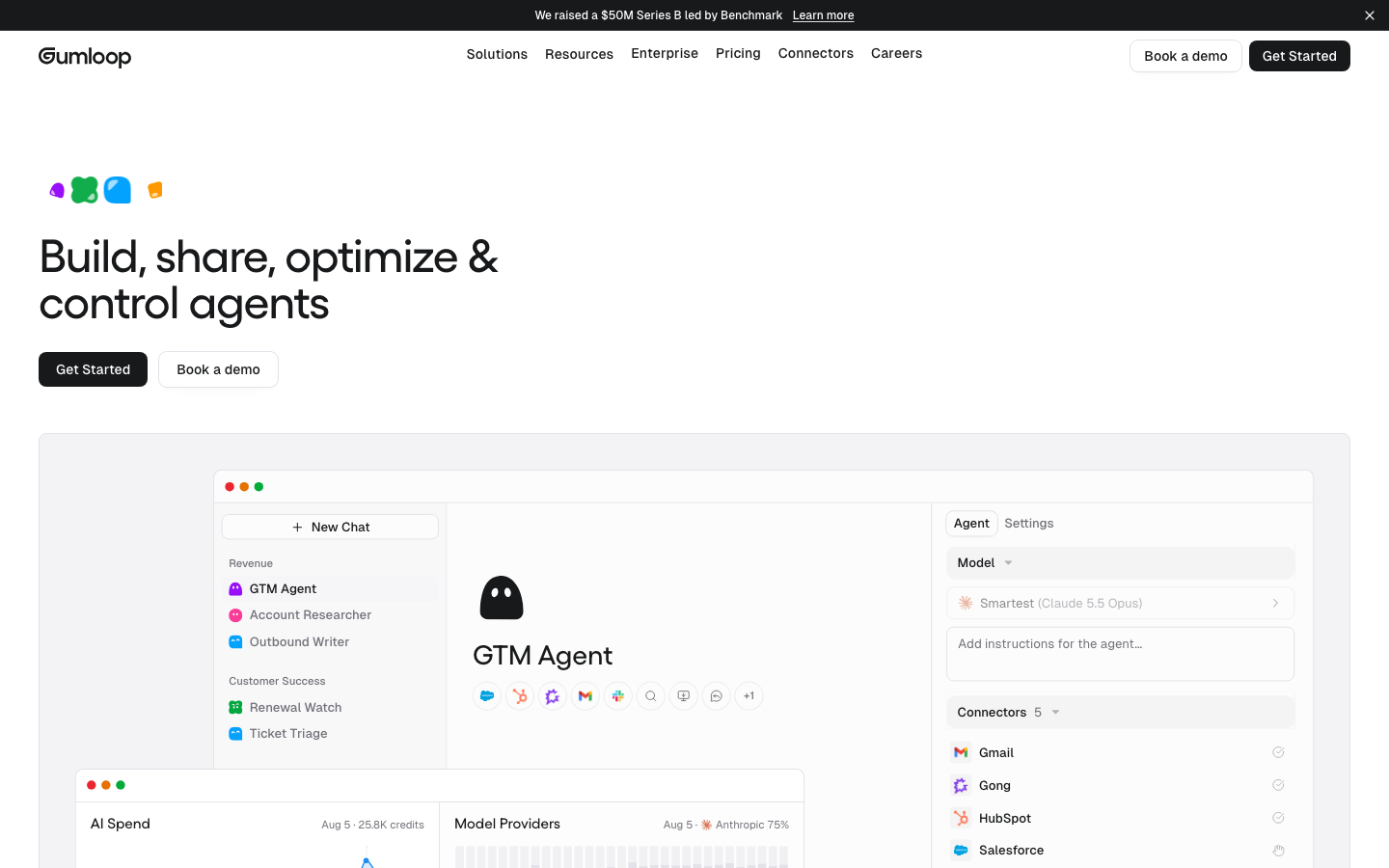
Gumloop's current product page emphasizes building and sharing agents, connecting tools, browser-based actions, human handoffs, and organization-wide usage visibility. Its positioning extends beyond the visual workflow canvas described in older comparisons.
Where it fits
Evaluate it when business teams need agents that work across their existing services. Test a specific job using the actual connector or browser route you would deploy. Confirm which identity is used, how credentials are shared, and what the operator sees when a site or service changes.
Pricing and limitations
The current pricing table lists Pro starting at $37 per month, 20,000 included monthly credits, an 8% orchestration fee, and custom Enterprise pricing. Ask how the fee and credits apply to your selected models and any keys you supply.
Check governance and deployment requirements against the actual Enterprise proposal; do not infer plan availability from a general product demonstration. For internal-database work, test the required query and update directly. A connector count or a browser demonstration does not establish whether your particular operation is supported reliably.
How to compare the platforms using one realistic pilot
Give every shortlisted tool the same business task and acceptance criteria. The following is a proposed evaluation sequence, not a benchmark result or a capability claim about every product.
| Test | What to demonstrate | What to record |
|---|---|---|
| Read the right data | Retrieve an allowed record and reject a disallowed one | Identity used, source, and permission boundary |
| Propose a change | Show the exact destination and parameters before approval | Reviewer context and rejection behavior |
| Recover from failure | Resume after a timeout or interrupted run | Whether completed writes are repeated |
| Handle an exception | Route missing information to a person | Owner, status, and next action |
| Estimate operating cost | Measure a successful case and a case with retries | Models, platform meters, external services, and human work |
Use fictional records and a test environment first. Keep the expected result alongside each example so evaluation does not depend on whether an answer sounds plausible. For the approval portion, our guide to building an approval workflow explains how to define the request, decision, and follow-up.
After the pilot, choose the architecture with a clear owner for every remaining manual step. A platform that handles more infrastructure can still leave application work; a flexible framework can require more operating effort. Compare the complete process your team will maintain.
Frequently asked questions
What is AI agent orchestration?
AI agent orchestration coordinates agent execution, tool calls, state, and handoffs within a process. It can involve several agents, but it also applies when one agent works inside a larger workflow that includes fixed rules and human review.
Do I need multiple agents?
No. Start with the smallest system that completes the task reliably. Add another agent when it has a distinct responsibility, useful tool boundary, or independent review role. Define the information passed between agents and how the workflow decides that a step is complete.
What is the difference between agent and workflow orchestration?
Workflow orchestration coordinates a defined process; agent orchestration also manages steps whose actions may be selected by a model. They can work together. Use fixed logic for requirements that must always hold and agent reasoning where interpreting an input or choosing a tool is useful.
Can an agent wait for human approval?
Yes, several tools document human review, including n8n tool approvals and LangGraph's human-in-the-loop execution. Verify what is paused, what the reviewer sees, and how the system resumes after rejection or a restart. A prompt asking the model to seek permission is not evidence of an enforced approval boundary.
What does agent orchestration cost?
Total cost depends on the platform, models, tool calls, storage, hosting, and people operating the process. Credit, conversation, and execution prices measure different things. Estimate cost per completed business task with a realistic retry case, using the plan and region you intend to buy.
Are LangGraph and CrewAI alternatives to a managed platform?
They are frameworks you can use to build agent applications, and their ecosystems also offer hosted services. Compare the framework and deployment layer separately. Your decision should account for execution control, observability, identities, user interfaces, and the team that will maintain them.
Can new customers still choose Amazon Bedrock Agents?
AWS states that Bedrock Agents Classic closed to new customers on July 30, 2026, while existing customers can continue using it. New evaluations should follow AWS's AgentCore guidance and verify the current service and migration requirements.
Build an agent workflow your team can operate
Choose around the process and the people responsible for it. If your agents need company data, a review queue, and business-facing screens, test that whole experience rather than evaluating only a model's response.
Create a Jet Admin project, connect a test data source, and map one workflow with an approval step. Confirm the permissions, exception handling, and operating cost before giving it production access.