Custom CRM
Overview
A custom CRM gives your business exactly the customer relationship management system it needs - no unnecessary features, no forced workarounds, no compromises on how you manage customer data. Unlike off-the-shelf CRM software that locks you into rigid workflows, a custom CRM solution adapts to your unique processes, data structures, and sales operations from day one.
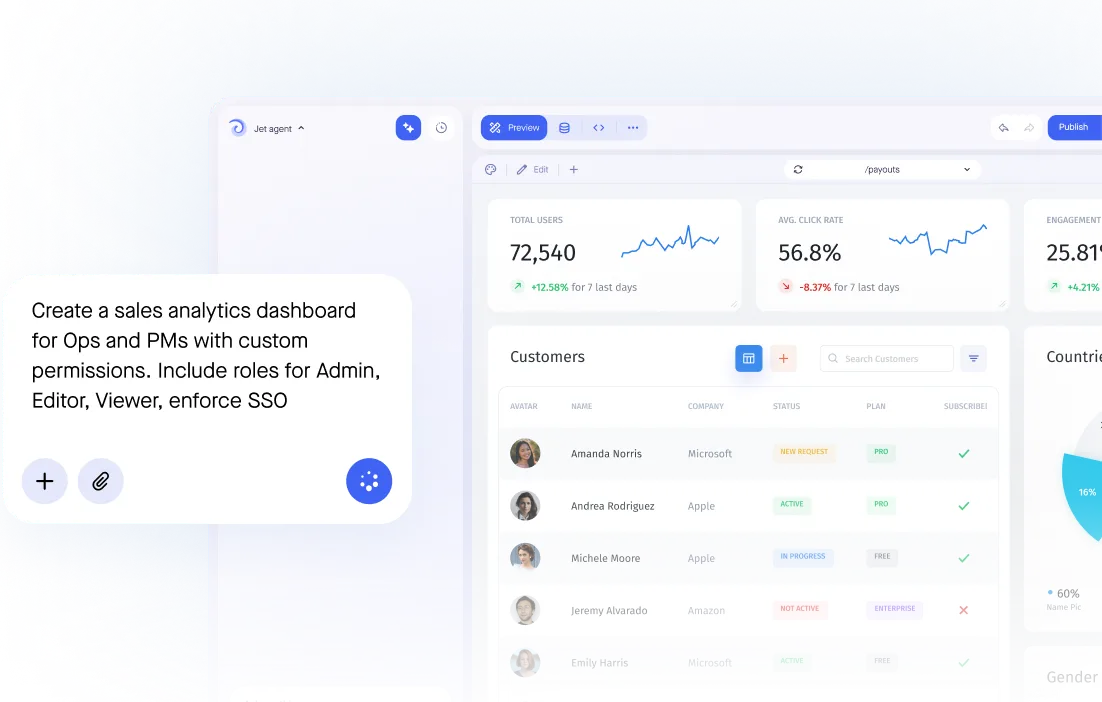
Jet Admin's AI-powered platform lets you generate a fully functional custom CRM template in minutes rather than months. The visual app builder produces a ready-to-use CRM system complete with drag-and-drop sales pipeline views, contact and lead management, real-time dashboards, role-based permissions, and deep data source connectivity - all without writing a single line of code.
Building a custom CRM from scratch typically means months of software development and costs that range from $18,000 to over $600,000. Custom CRM development timelines can exceed one year. With Jet Admin's template approach, you skip the expensive engineering cycle entirely. You get pre-configured best practices - Kanban boards, activity timelines, custom reports, workflow automation - baked into a foundation that's fully editable to match your business processes. This is the most customizable CRM starting point available: connect your own databases, APIs, and existing tools, then shape every field, workflow, and permission to build a custom CRM that's truly your own.
What makes this CRM template unique is the combination of speed, depth, and control. Over 60 pre-built UI components, 30+ data source connectors, AI-assisted app generation, granular permissions at both the UI and data level, and the option to self-host for complete data security - all accessible to business users, not just developers.
Why Use This Custom CRM Template
Saves massive development time and cost. Developing a custom CRM from the ground up demands hiring engineers, designers, and QA teams. Building a minimum viable product can reduce initial costs, but even then, custom CRM development costs range from $18,000 to over $600,000 depending on complexity. Off-the-shelf CRM implementation costs range from $5,000 to $80,000 for initial setup alone. This template eliminates those burdens - you go from zero to a working CRM platform in hours, not months, dramatically reducing your custom CRM project budget.
No expensive developers required. The entire setup, customization, and iteration process happens through Jet Admin's visual app builder and drag-and-drop interface. Custom CRM apps can automate routine tasks like data entry without code. Business users can modify fields, pipeline stages, dashboards, and permissions independently, reducing reliance on engineering teams while still producing a powerful crm solution.
Pre-configured with proven CRM functionality. The template ships with essential key features already in place: contact management, lead tracking, pipeline management, activity timelines, reporting dashboards, and role-based access. Custom CRMs reduce feature bloat by eliminating unnecessary out-of-the-box functionality - you start with what matters and add only what your business needs.
Fully customizable to your business workflows. A custom CRM allows businesses to tailor workflows that reflect their unique operations. Whether you run multi-tiered account hierarchies, subscription models, or partner sales cycles, this template accommodates custom fields, tags, deal stages, and data relationships. Custom fields allow capturing specific information that generic CRM software simply can't handle. Customizable layouts help manage sales for multiple products, and you control every aspect of how customer information flows through your system.
Built-in integrations with your data ecosystem. Custom CRMs can integrate with nearly 900 applications. Jet Admin natively supports connections to PostgreSQL, MySQL, MongoDB, REST and GraphQL APIs, Airtable, CSV imports, and more. Integration with existing systems is critical to ensure seamless data flow - this template connects marketing, sales, and finance data in a centralized location, eliminating data silos for better decision-making.
Template Features
- Contact and lead management with customizable fields and tags. Manage contacts, leads, and accounts with fields tailored to your industry - lead source, custom tags, account tier, and more. Custom CRMs enable businesses to define specific data relationships and structures, so contacts link properly to accounts and deals. Full-text search, advanced filters, and import from CSV or external systems keep your customer data clean and accessible. Custom CRM systems provide a centralized repository for customer data enhancing reporting.
- Sales pipeline tracking with drag-and-drop deal stages. Visualize your entire sales funnel with a multi-stage Kanban board. Move deals between custom stages with drag-and-drop, track deal values, probabilities, and stage history. Customizable dashboards can display key information tailored to user preferences, including pipeline value, forecasted revenue, and deal velocity. A high-performing CRM connects marketing, sales, and finance data for complete pipeline visibility.
- Task and activity management with automated reminders. Link tasks, calls, meetings, and follow-ups directly to contacts and deals. Activity timelines show the full history of every interaction. Automated reminders flag overdue tasks and upcoming deadlines, ensuring sales team members never miss a critical touchpoint. Custom CRM apps can automate routine tasks, and workflow automation handles lead nurturing sequences and escalation rules.
- Email integration and campaign tracking capabilities. Sync with Gmail, Outlook, or any email service via API. Send communications directly from the CRM, track opens and clicks, and use templates for consistent outreach. Track marketing campaigns by cohort, measure ROI, and attribute leads to specific channels. Custom CRMs can automate specific tasks and provide predictive analytics for sales, helping you prioritize potential customers and optimize marketing automation.
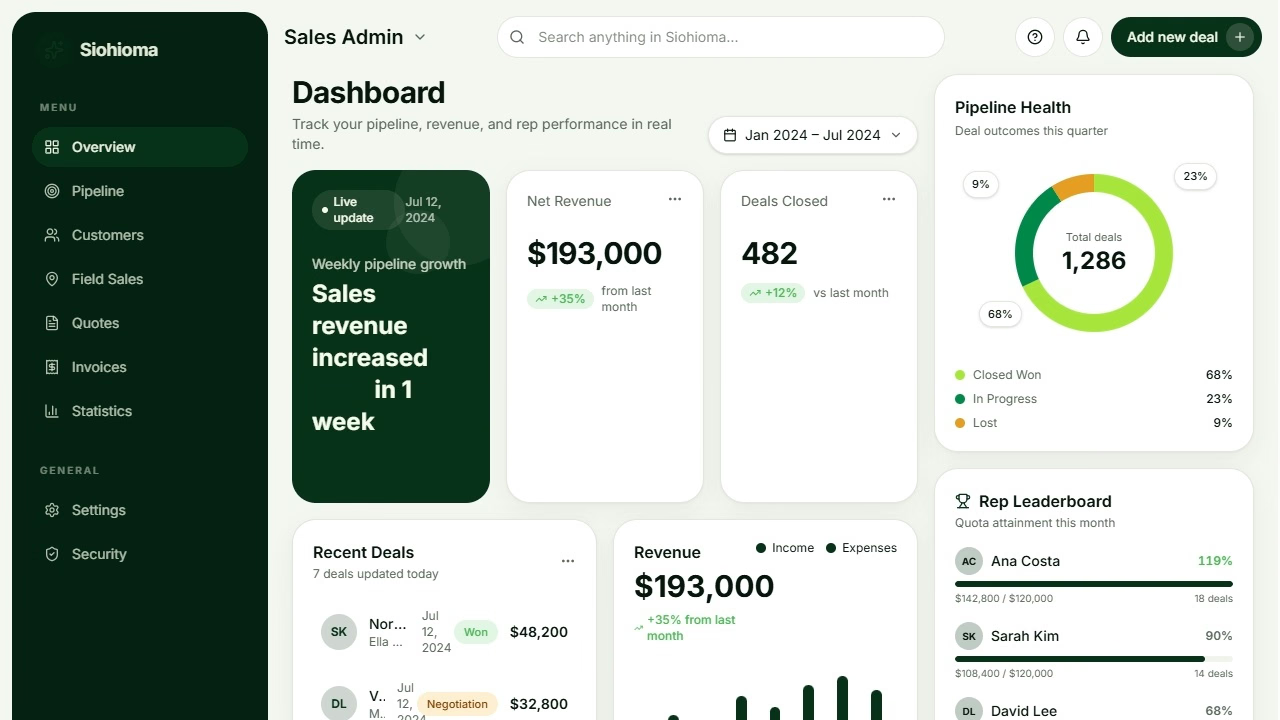
- Reporting dashboard with real-time analytics and KPI tracking. Custom CRMs should allow for personalized dashboards and reporting based on KPIs. The template includes pre-built dashboard widgets - charts, graphs, trend comparisons - showing metrics like win rate, average deal size, lead conversion rates, and time in stage. Drill down from summary views into deal and account details. Use historical data and data analysis to identify trends and forecast future sales trends.
- Role-based permissions and team collaboration tools. Role-based access control in CRMs protects sensitive customer information. Define admin, manager, and rep roles with granular control over data visibility, CRUD permissions, and UI component access. Collaboration tools include comments on records, shared views, and activity logs. Audit trails track every change for compliance and governance.
- Mobile-responsive design for access from any device. The cloud based CRM interface adapts to desktop, tablet, and mobile screens, ensuring remote and field sales representatives can access deals, dashboards, and tasks from anywhere. Mobile access is no longer optional - it's essential for modern sales teams working in hybrid environments.
- Workflow automation for lead nurturing and follow-ups. Automation in custom CRMs can enhance efficiency by mapping specific business processes. Set triggers based on deal stage changes, time-based conditions, or data thresholds. Automate repetitive tasks like assignment rules, notification delivery, follow-up scheduling, and status updates. AI agents automate tasks like lead qualification and customer inquiries, while AI-driven capabilities provide insights that improve sales strategies and customer engagement. Custom CRMs can leverage AI for advanced customer analytics and segmentation.
Who Is This Custom CRM Template For?
- Small to medium businesses upgrading from spreadsheets or basic tools. If you're managing customer relationships in spreadsheets, email threads, or disconnected apps, this template gives you a professional CRM system with real pipeline visibility, account management, and analytics - without enterprise-level pricing. Building custom CRM systems with a template approach means you can start simple and scale as your team grows. Scalability is a key aspect of custom CRM solutions, allowing for future growth.
- Sales teams needing better pipeline visibility and lead tracking. Sales operations teams that need to track deals across stages, monitor sales data, forecast revenue, and hold sales representatives accountable benefit immediately from the pipeline views, activity tracking, and custom reports this template provides. AI-driven insights improve sales strategies and customer engagement, helping you refine your sales processes over time.
- Companies with unique processes that don't fit standard CRM solutions. Off-the-shelf platforms like Zoho CRM, Salesforce, or HubSpot impose data models that don't always align with business logic. If your business runs subscription-based models, multi-stakeholder deals, regulatory workflows, or non-standard sales cycles, this customizable CRM software molds to your customer related processes rather than forcing you to adapt. Custom CRMs can be tailored to unique business processes, and a custom CRM can streamline operations across all departments.
- Organizations wanting to avoid escalating per-seat subscription costs. As teams grow, commercial CRM platforms charge $15 to $300+ per user per month - and enterprise tiers add up fast. Custom CRMs can be more cost-efficient than off-the-shelf solutions, particularly for businesses with more than 20–50 users. Several comparative analyses show that custom systems may achieve lower 5-year Total Cost of Ownership for complex use cases. Own your own CRM solution instead of renting features you don't need.
- Businesses requiring specific integrations with legacy systems and databases. If your relevant data lives across proprietary operational systems, billing platforms, product databases, or customer success tools, this template's 30+ connectors and API support let you build a unified view. Custom CRMs can integrate with existing internal systems seamlessly, and custom CRM solutions can connect to SQL databases and APIs. Custom CRM development allows seamless communication with other software, ensuring you can document management store and manage important customer documents in one place.
How to Set Up Your Custom CRM Template
Step 1: Generate the template using Jet Admin's AI app generator. Start by selecting the Custom CRM Template from Jet Admin's library. The AI generates a fully functional CRM with default entities - deals, contacts, accounts, pipeline stages - ready for immediate use. Review the structure, then import sample data or a small subset of actual records to validate the setup. The implementation of a custom CRM typically follows several defined stages to ensure success, and generating the template is your fastest first step.
Step 2: Connect your data sources. Map where your customer data currently lives - SQL databases, MongoDB, third-party SaaS tools, CSV files, spreadsheets. Set up connectors to PostgreSQL, MySQL, REST/GraphQL APIs, or other sources. If you're prototyping, use Jet Admin's built-in Postgres database, then migrate to your production environment later. Ensure schema alignment: how accounts, contacts, and deals relate to each other across your systems. Custom CRM solutions should support strong data quality and governance practices from the start.
Step 3: Customize fields, workflows, and user permissions. Tailor every aspect to match your business needs. Add custom fields and tags for industry-specific data. Modify pipeline stages, probabilities, and deal relationships. Set up role-based permissions - define who sees which deals, accounts, and dashboards. Configure UI visibility so that each team member sees only the components relevant to their role. Choosing a custom CRM solution requires aligning software capabilities with business needs, and this step is where that alignment happens.
Step 4: Configure integrations with email, calendar, and other business tools. Connect email services (Gmail, Outlook, or via API), calendar and scheduling tools, marketing platforms, and support tools. Define sync direction - one-way or bi-directional - and frequency. Set up email templates for consistent outreach. Link your existing tools for campaign tracking and attribution. Custom CRMs can integrate with existing internal systems seamlessly, ensuring no data is left stranded.
Step 5: Set up automated workflows and notification rules. Define your key automations: follow-up tasks triggered after deal stage changes, reminder emails after periods of inactivity, escalation rules for stalled deals, automatic task assignment based on territory or account type. Use workflow automation to automate repetitive tasks that drain your team's time. Customizable CRM systems enable the automation of repetitive tasks to improve productivity. Test notifications to ensure alerts reach the right people through the right channels.
Step 6: Train your team and launch your custom CRM system. User adoption is crucial for the success of a CRM implementation. Conduct training sessions covering workflows, terminology, and daily usage patterns. Run a pilot with a subset of sales team members to surface friction points and missing features. Gather feedback, iterate on the design, and clean up any duplicate records or inconsistent field usage. Custom CRMs can improve user adoption rates significantly when the system reflects how people actually work. Once stable, roll out to all users and monitor adoption metrics - login frequency, activity capture, pipeline engagement - to drive continuous improvement. Effective use of a custom CRM can lead to improved customer satisfaction through tailored experiences.
Frequently Asked Questions
How long does it take to set up the custom CRM template? A basic working version can be up and running in under an hour - importing data, defining pipeline stages, and enabling core dashboards. Full configuration including integrations, advanced features, custom permissions, workflow automation, and team training typically takes several days to a few weeks depending on your data complexity and number of connected systems.
Can I integrate the CRM with my existing database and tools? Yes. Jet Admin supports direct connections to SQL databases (PostgreSQL, MySQL), NoSQL (MongoDB), REST and GraphQL APIs, and 30+ data source connectors. You can start with CSV or Excel imports and progressively integrate external systems. Custom CRMs can eliminate data silos for better decision-making by pulling all relevant data into one centralized location.
Is coding knowledge required to customize the template? No coding is required for the vast majority of tasks. Field definitions, pipeline configurations, dashboards, permission rules, and workflow automations are all handled through point-and-click or drag-and-drop interfaces. For edge cases, Jet Admin supports custom JavaScript and conditional logic, but most business users will never need it. This is customizable CRM software built for operations teams, not engineers.
What data sources can I connect to the CRM? Native support includes PostgreSQL, MySQL, MongoDB, built-in database for prototyping, REST and GraphQL APIs for SaaS integrations, and CSV/XLS file uploads. Custom CRM solutions can connect to SQL databases and APIs, and you can display data from multiple sources within the same interface or link them via relationships.
How much does it cost compared to traditional CRM solutions? Traditional CRM platforms charge $15 to $300+ per user per month, with enterprise features locked behind premium tiers. Building a custom CRM from scratch costs between $18,000 and $600,000, with ongoing maintenance adding 15–25% of the initial build cost annually. Costs depend on the complexity and required features of the CRM. With Jet Admin's template approach, you pay platform licensing plus your own configuration time - a fraction of either alternative, with lower TCO over 3–5 years for most growing teams.
Can multiple team members access and use the CRM simultaneously? Absolutely. The template supports collaborative access with role-based permissions, shared dashboards, team views, and concurrent usage across contacts and deals. A custom CRM enhances data security by allowing control over how customer data is stored and who can access it - each user sees only what their role permits.
Is the CRM template mobile-friendly and accessible from anywhere? Yes. The interface is web-based and designed responsively, working across desktop, tablet, and mobile browsers. Critical interactions - viewing deals, updating statuses, checking dashboards, managing tasks - are fully accessible on mobile. This cloud based approach means your sales teams and field representatives can work from anywhere.
What support is available during setup and customization? Jet Admin provides comprehensive documentation, a templates library, onboarding resources, and community support. For complex integrations or specialized custom logic, professional services and consulting options are available. The platform handles maintenance, updates, and security patches, so you can focus on building the CRM program your business needs rather than managing infrastructure. Custom CRMs should provide compliance support for regulations like GDPR and HIPAA, and the platform's self-hosting option gives you full control over data residency when required.
Data sources

.svg)

Use Cases
Categories
Features
Similar templates



Build frontend Apps 10x faster


Frequently asked questions
Jet Admin provides comprehensive documentation, a templates library, onboarding resources, and community support. For complex integrations or specialized custom logic, professional services and consulting options are available. The platform handles maintenance, updates, and security patches, so you can focus on building the CRM program your business needs rather than managing infrastructure. Custom CRMs should provide compliance support for regulations like GDPR and HIPAA, and the platform's self-hosting option gives you full control over data residency when required.
Yes. The interface is web-based and designed responsively, working across desktop, tablet, and mobile browsers. Critical interactions - viewing deals, updating statuses, checking dashboards, managing tasks - are fully accessible on mobile. This cloud based approach means your sales teams and field representatives can work from anywhere.
Absolutely. The template supports collaborative access with role-based permissions, shared dashboards, team views, and concurrent usage across contacts and deals. A custom CRM enhances data security by allowing control over how customer data is stored and who can access it - each user sees only what their role permits.
Traditional CRM platforms charge $15 to $300+ per user per month, with enterprise features locked behind premium tiers. Building a custom CRM from scratch costs between $18,000 and $600,000, with ongoing maintenance adding 15–25% of the initial build cost annually. Costs depend on the complexity and required features of the CRM. With Jet Admin's template approach, you pay platform licensing plus your own configuration time - a fraction of either alternative, with lower TCO over 3–5 years for most growing teams.
Native support includes PostgreSQL, MySQL, MongoDB, built-in database for prototyping, REST and GraphQL APIs for SaaS integrations, and CSV/XLS file uploads. Custom CRM solutions can connect to SQL databases and APIs, and you can display data from multiple sources within the same interface or link them via relationships.
No coding is required for the vast majority of tasks. Field definitions, pipeline configurations, dashboards, permission rules, and workflow automations are all handled through point-and-click or drag-and-drop interfaces. For edge cases, Jet Admin supports custom JavaScript and conditional logic, but most business users will never need it. This is customizable CRM software built for operations teams, not engineers.
Yes. Jet Admin supports direct connections to SQL databases (PostgreSQL, MySQL), NoSQL (MongoDB), REST and GraphQL APIs, and 30+ data source connectors. You can start with CSV or Excel imports and progressively integrate external systems. Custom CRMs can eliminate data silos for better decision-making by pulling all relevant data into one centralized location.
A basic working version can be up and running in under an hour - importing data, defining pipeline stages, and enabling core dashboards. Full configuration including integrations, advanced features, custom permissions, workflow automation, and team training typically takes several days to a few weeks depending on your data complexity and number of connected systems.
Diverse businesses, from startups to enterprise companies in the healthcare, finance, and e-commerce sectors. For companies that depend on internal tools, portals, and dashboards for their workflow, offering the capability to craft customized applications suited to their requirements
Jet Admin is a development platform that allows developers to quickly build custom business apps like internal tools, portals, dashboards for their businesses. Jet offers a drag-and-drop interface and pre-built components, making it easy to create applications while writing little code.